Outstanding weight-loss outcomes and proven safety, backed by an extensive library of published research and work with Harvard and Mayo Clinic.

The Metabolic and Bariatric Surgery Accreditation and Quality Improvement Program (MBSAQIP®) is a national quality program that verifies bariatric centers meet rigorous standards for safety, outcomes, and comprehensive care. Verify on FACS (MBSAQIP)

QUAD A surveys outpatient surgery centers for emergency readiness, sterile processing, anesthesia safety, and continuous quality review. Eviva partnered with QUAD A in the early 2000s to help shape these standards and continues to exceed their stringent requirements. Verify on QUAD A
Aetna’s IOQ program recognizes facilities that meet defined standards for quality and cost-efficiency—considering factors like case volume, outcomes, readmissions, and complications.
Blue Distinction recognizes hospitals that demonstrate expertise in bariatric surgery; Center+ adds cost-efficiency criteria to quality measures.
UHC/Optum designates bariatric Centers of Excellence based on program quality, experience, and outcomes; members are directed to confirm eligibility through their benefits.
Introduction
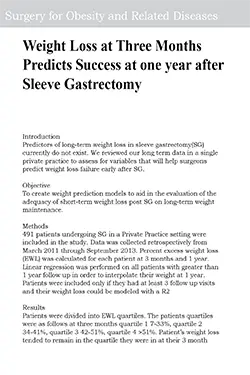
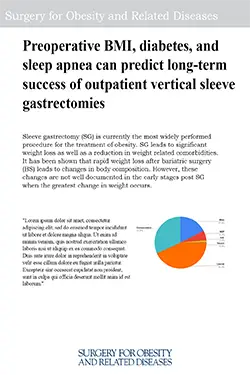
Predictors of long-term weight loss in sleeve gastrectomy(SG) currently do not exist. We reviewed our long term data in a single private practice to assess for variables that will help surgeons predict weight loss failure early after SG.
Objective
To create weight prediction models to aid in the evaluation of the adequacy of short-term weight loss post SG on long-term weight maintenance.
Methods
491 patients undergoing SG in a Private Practice setting were included in the study. Data was collected retrospectively from March 2011 through September 2013. Percent excess weight loss (EWL) was calculated for each patient at 3 months and 1 year. Linear regression was performed on all patients with greater than 1 year follow up in order to interpolate their weight at 1 year. Patients were included only if they had at least 3 follow up visits and their weight loss could be modeled with a R2
Results
Patients were divided into EWL quartiles. The patients quartiles were as follows at three months quartile 1 7-33%, quartile 2 34-41%, quartile 3 42-51%, quartile 4 >51%. Patient’s weight loss tended to remain in the quartile they were in at their 3 month visit, especially those in the 1st and 4th quartiles. The positive and negative predictor values at 12 months for the 1st quartile results were 70% and 84% respectively.
Conclusions
We are the first group with data documenting that short-term weight loss can predict long-term weight loss success or failure quite accurately. Identifying failure early is critical to the long-term success of the bariatric patient. This knowledge will allow surgeons to discuss intervention such as medication, lifestyle or conversion to gastric bypass or duodenal switch reoperations at three months rather than waiting years for weight regain to occur.
Abstract
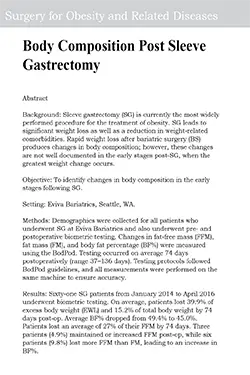
Background: Sleeve gastrectomy (SG) is currently the most widely performed procedure for the treatment of obesity. SG leads to significant weight loss as well as a reduction in weight-related comorbidities. Rapid weight loss after bariatric surgery (BS) produces changes in body composition; however, these changes are not well documented in the early stages post-SG, when the greatest weight change occurs.
Objective: To identify changes in body composition in the early stages following SG.
Setting: Eviva Bariatrics, Seattle, WA.
Methods: Demographics were collected for all patients who underwent SG at Eviva Bariatrics and also underwent pre- and postoperative biometric testing. Changes in fat-free mass (FFM), fat mass (FM), and body fat percentage (BF%) were measured using the BodPod. Testing occurred on average 74 days postoperatively (range 37–136 days). Testing protocols followed BodPod guidelines, and all measurements were performed on the same machine to ensure accuracy.
Results: Sixty-one SG patients from January 2014 to April 2016 underwent biometric testing. On average, patients lost 39.9% of excess body weight (EWL) and 15.2% of total body weight by 74 days post-op. Average BF% dropped from 49.4% to 45.0%. Patients lost an average of 27% of their FFM by 74 days. Three patients (4.9%) maintained or increased FFM post-op, while six patients (9.8%) lost more FFM than FM, leading to an increase in BF%.
Conclusion: The goal of BS is to reduce weight and weight-related comorbidities. However, weight reduction alone is not sufficient to assess success post-SG. Patients losing more FFM than FM should be identified early to optimize outcomes. Achieving a healthy body composition, rather than only focusing on weight loss, should be emphasized. Future studies should identify factors influencing FFM preservation and evaluate long-term body composition results in SG patients.
Background
Currently there are no models to predict a patient’s ability to succeed at a surgery before they receive it. Because of this many surgeons disagree on what procedures to offer to their patients and what variable should influence this decision.
Objective
To create a statistical model that predicts failure in a sleeve patient before surgery.
Methods
491 patients undergoing SG in a Private Practice setting were included in this study. Data was collected retrospectively from March 2011 through September 2013. Percent excess weight loss (EWL) was calculated for each patient at 1 year. Linear regression was performed on all patients with greater than 1 year follow up in order to interpolate their weight at 1 year. Patients were included only if they had at least 3 follow up visits and their weight loss could be modeled with a R2>0.95.
Results
Patients were divided into EWL quartiles. The patients quartiles were as follows at one year quartile 1 9-54%, quartile 2 55-68%, quartile 3 69-84%, quartile 4 >85%. Patients in the first quartile at one year were defined as failing the procedure. The positive and negative predictor values for our model were 58% and 81% respectively with sensitivity at 33% and specificity at 92%. The multivariate analysis indicated that diabetes, sleep apnea, and preoperative BMI were statistically significant
Conclusions
We are the first group to show that weight loss at 1 year can be predicted before the surgery is performed. Patients with sleep apnea, diabetes, and a BMI greater than 48 should not be offered a sleeve gastrectomy because of the high failure probability
Context
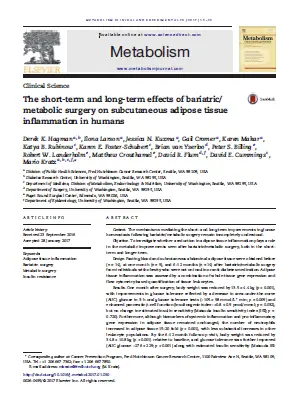
The mechanisms mediating the short- and long-term improvements in glucose homeostasis following bariatric/metabolic surgery remain incompletely understood.
Objective
To investigate whether a reduction in adipose tissue inflammation plays a role in the metabolic improvements seen after bariatric/metabolic surgery, both in the short-term and longer-term.
Design
Fasting blood and subcutaneous abdominal adipose tissue were obtained before (n=14), at one month (n=9), and 6–12 months (n=14) after bariatric/metabolic surgery from individuals with obesity who were not on insulin or anti-diabetes medication. Adipose tissue inflammation was assessed by a combination of whole-tissue gene expression and flow cytometry-based quantification of tissue leukocytes.
Results
One month after surgery, body weight was reduced by 13.5±4.4 kg (p<0.001), with improvements in glucose tolerance reflected by a decrease in area-under-the-curve (AUC) glucose in 3-h oral glucose tolerance tests (−105±98 mmol/L*min; p=0.009) and enhanced pancreatic β-cell function (insulinogenic index: +0.8±0.9 pmol/mmol; p=0.032), but no change in estimated insulin sensitivity (Matsuda insulin sensitivity index [ISI]; p=0.720). Furthermore, although biomarkers of systemic inflammation and pro-inflammatory gene expression in adipose tissue remained unchanged, the number of neutrophils increased in adipose tissue 15–20 fold (p<0.001), with less substantial increases in other leukocyte populations. By the 6–12 month follow-up visit, body weight was reduced by 34.8±10.8 kg (p<0.001) relative to baseline, and glucose tolerance was further improved (AUC glucose −276±229; p<0.001) along with estimated insulin sensitivity (Matsuda ISI: +4.6±3.2; p<0.001). In addition, improvements in systemic inflammation were reflected by reductions in circulating C-reactive protein (CRP; −2.0±5.3 mg/dL; p=0.002), and increased serum adiponectin (+1,358±1,406 pg/mL; p=0.003). However, leukocyte infiltration of adipose tissue remained elevated relative to baseline, with pro-inflammatory cytokine mRNA expression unchanged, while adiponectin mRNA expression trended downward (p=0.069).
Conclusion
Both the short- and longer-term metabolic improvements following bariatric/metabolic surgery occur without significant reductions in measures of adipose tissue inflammation, as assessed by measuring the expression of genes encoding key mediators of inflammation and by flow cytometric immunophenotyping and quantification of adipose tissue leukocytes.
Keywords: adipose tissue inflammation, bariatric surgery, metabolic surgery, insulin resistance

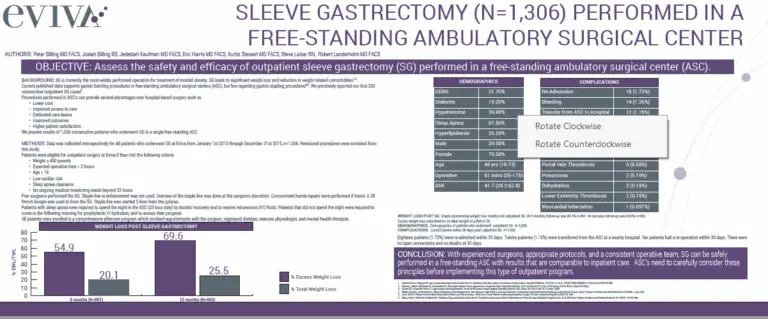
Sleeve gastrectomy (SG) is currently the most widely performed procedure for the treatment of morbid obesity. SG leads to significant weight loss as well as a reduction in weight related comorbidities. Procedures performed in ambulatory surgical centers (ASC) can provide several advantages over hospital-based surgery. We present our results of 1036 consecutive patients who underwent SG in an ASC.
Background
Procedures performed in ambulatory surgical centers (ASC) can provide several advantages over hospital-based surgery. Understandably, concerns have been raised regarding “high acuity” cases in the ASC setting. Recently the Metabolic and Bariatric Surgery Accreditation and Quality Improvement Program (MBSAQIP) presented protocols for ASCs to follow, requiring them to perform only “low acuity” cases to be compliant with accreditation.
Thorough evaluations, labs, and education to prep you for surgery. Learn what to expect, how to optimize outcomes, and follow personalized instructions for your health and schedule.
Labs and diagnostic testing
Psychological and sleep evaluations
Nutrition consultations
Pre-op education and preparation
Expert bariatric team, accredited facility, streamlined check-in, and a safety-first experience. From anesthesia to procedure to recovery with clear, compassionate communication.
Pre-admissions testing & screening
Surgical & Anesthesia review
Surgery & recovery care
Discharge instructions
Ongoing support to protect your results and overall health long after surgery.
Surgeon follow-ups for ongoing medical care
Medications when clinically indicated
Nutrition coaching led by registered dietitians
Peer support groups for community connection
Guided activities to build lasting healthy habits
4.9Top Rated Service 2026verified by TrustindexTrustindex verifies that the company has a review score above 4.5, based on reviews collected on Google over the past 12 months, qualifying it to receive the Top Rated Certificate.
Hundreds of five-star reviews reflect the trust and gratitude of our patients.